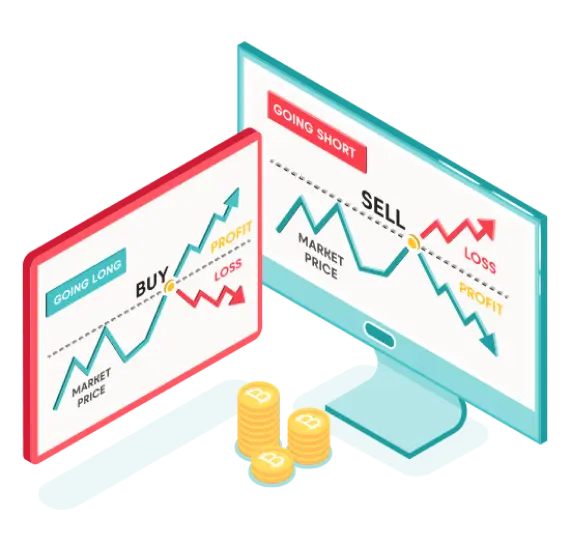
Cryptocurrencies, especially Bitcoin, are becoming increasingly popular, and many people are currently wondering how and where to trade Bitcoin. The number of people willing not only to buy (invest) but also to trade is growing. Bitcoin trading on the exchange It's an opportunity to profit from changes in the asset's value by buying, selling, or trading it. The advantage is that you can trade any day of the week, 24 hours a day, 365 days a year – cryptocurrencies are a completely decentralized asset.
⚡ TOP 5 cryptocurrency exchanges for Bitcoin according to experts:
- Binance An international exchange that offers trading in Bitcoin and other cryptocurrencies.
- Bybit An exchange focused on Bitcoin derivatives and other popular digital assets.
- OKX A convenient cryptocurrency exchange with Bitcoin and a decentralized ecosystem.
- Mexico A cryptocurrency platform that supports the exchange of Bitcoin and many altcoins.
- cooperative The global brokerage that provides BTC trading and storage services has been operating since 2013.
- KuCoin A popular exchange for trading bitcoins with low fees.
- Gate.io An exchange that offers perhaps the widest selection of currencies for trading, including Bitcoin.
- Bitget A platform specializing in trading Bitcoin contracts, with a focus on copy trading.
- BingX A BTC exchange that offers convenient and fast transactions.
Bitcoin trading exchanges, comparison chart :
| Exchange name | Link to website | Does it work worldwide? | Booking confirmation | Mandatory verification | Demo account | Trading Fees |
|---|---|---|---|---|---|---|
| Binance | binance.com | Yes | ✓ | Yes | Yes | Spot: 0.15 to 0.1%. Futures: maker* -0.01 to 0.05%. |
| Bybit | bybit.com | Yes | ✓ | Yes | Yes | Spot: from 0 to 0.1%. Futures: from 0 to 0.06%. |
| OKX | okx.com | Yes | ✓ | No | Yes | Spot: from -0.05 to 0.1%. Futures: from 0.005 to 0.05%. |
| Mexico | mexc.com | Yes | – | No | Yes | Spot: from 0 to 0.2%. Futures: from 0.014 to 0.06%. |
| cooperative | huobi.com | Yes | ✓ | No | No | Spot: from 0.0097 to 0.2%. Futures: from 0.005 to 0.05%. |
| Exchange Payeer | payeer.com/trade | Yes | – | No | No | Local: 0,095%. |
| KuCoin | kucoin.com | Yes | ✓ | Yes | No | Spot: from -0.005 to 0.1%. Futures: from 0.014 to 0.06%. |
| Gate.io | Gate.io | Yes | ✓ | No | No | Spot market: 0 to 0.2%. Futures: 0 to 0.05% |
| Bitget | bitget.com | Yes | ✓ | Yes | Yes | Spot: up to 0.1%. Futures: up to 0.05% |
| BingX | bingx.com | Yes | ✓ | No | Yes | Spot: up to 0.1%. Futures: up to 0.05% |
Experts studied the advantages and disadvantages of trading BTC cryptocurrencies on cryptocurrency exchanges and also provided a list of exchanges for trading. When choosing platforms, we relied on our own experience, official information, reviews, and a number of other indicators.
How do we choose the best BTC cryptocurrency exchanges?
Bitcoin is supported by all centralized cryptocurrency exchanges, and is the most popular and widely traded cryptocurrency.
When choosing a suitable platform, experts recommend paying attention to the trading pairs in which Bitcoin is available, the trading volumes and liquidity on the exchange, its reputation, and security. Are the platform's reserves confirmed? How transparent is it? Does management communicate with clients or hide their identity? Fees, additional trading and investment features are important.
1. Binance
- Trading types: spot, futures, p2p
- Daily trading volume (spot market): $14,348,309,936
- Daily trading volume (futures): $49,576,620,655
- Year founded: 2017
- Number of trading pairs or contracts: 1457 / 214
- Verification: required
- binance.com
Binance It is a popular cryptocurrency exchange with top liquidity. The company represents spot, margin, futures, P2P, and investment products. You can trade not only Bitcoin but also hundreds of altcoins: Ethereum, Litecoin, Dash, EOS, Monero, Stellar, Cardano, etc. The exchange was founded in 2017 and ranks first in terms of trading volume.
2. Bybit
- Trading types: spot, futures, p2p
- Daily trading volume (spot market): $526,260.842
- Daily trading volume (futures): $8,415,142,216
- Year founded: 2018
- Number of trading pairs or contracts: 216 / 175
- Verification: required
- bybit.com
Bybit is registered in the British Virgin Islands. . It offers the opportunity to trade on margin with leverage up to 100x, fees of -0.06% for the maker, 0.01% for the taker (futures) and 0.1% (spot). There is an opportunity to receive bonuses for the initial deposit and reaching certain trading volumes. You cannot withdraw bonuses; you can only use them for trading.
3. OKX
- Trading types: spot, futures, p2p
- Daily trading volume (spot market): $2,854,374,579
- Daily trading volume (futures): $15,384,988,599
- Year founded: 2013
- Number of trading pairs or contracts: 522 / 324
- Verification: required
- okx.com
OKX It is a platform formerly known as OKEx, which was spun off from OKCoin in 2013. Focused on providing simple and convenient tools for trading and investing in Bitcoin. It includes many blockchain infrastructure and decentralized finance components.
4. Cooperative
Trading types: spot, futures, p2p
- Daily trading volume (spot market): $1,585,924,981
- Daily trading volume (futures): $1,656,514,336
- Year founded: 2013
- Number of trading pairs or contracts: 952 / 232
- Verification: not required
- htx.com
A exchange HTX Global It is one of the oldest and most reliable on the market. Besides Bitcoin, it supports hundreds of other cryptocurrencies, as well as rare tokens. There is an HT swap token. With a certain amount, you can buy VIP status and save on fees. The service is especially relevant for institutional investors.
5. Mexico
- Trading types: spot, futures, p2p
- Daily trading volume (spot market): $2,074,514,031
- Daily trading volume (futures): $11,549,528,391
- Year founded: 2018
- Number of trading pairs or contracts: 1943 / 214
- Verification: not required
- mexc.com
MEX (formerly MXC) is a platform that supports the spot market, futures, index ETFs, leveraged ETFs, and P2P exchange. In short, it has all the necessary tools to trade Bitcoin or maximize savings in different ways. Among the ways to earn passively are the IEO platform, staking, DeFi mining, and much more.
6. BingX
- Trading types: spot, futures, p2p
- Daily trading volume (spot market): $605,575,571
- Daily trading volume (futures): $9,451,040,032
- Year founded: 2018
- Number of trading pairs or contracts: 578 / 168
- Verification: not required
- bingx.com
BingX (formerly Bingbon) is a cryptocurrency platform that allows you to trade Bitcoin on the spot market or access derivatives of this currency. Users receive a user-friendly trading interface, no KYC required, bonuses, a referral program, a demo account, and much more.
7. Bitget
- Trading types: spot, futures, p2p
- Daily trading volume (spot market): $618,791,810
- Daily trading volume (futures): $8,343,786,254
- Year founded: 2018
- Number of trading pairs or contracts: 648 / 218
- Verification: required
- bitget.com
Bitget It is a Bitcoin trading exchange with a wide range of automation tools. A complete strategy marketplace is available – you can subscribe to trades from experienced traders and copy them automatically. You can also create your own strategies by setting up trading bots.
8. BitMEX
- Types of trading: futures
- Daily trading volume (futures): $791,174,185
- Year founded: 2014
- Number of trading pairs or contracts: 53
- Verification: required
- bitmex.com
A exchange BitMEX It is a platform for trading XBTUSD perpetual futures contracts and others, as well as contracts with expiration dates (quarterly, weekly). The exchange offers Bitcoin trading with leverage from 1x to 100x. For example, having 1 BTC in your account, you can make transactions with a turnover of 100 BTC using maximum leverage.
Trading can be opened for selling (short) or buying (long): to hedge risks or speculate on the price. No matter where the market is going, you can make money when the BTC rate falls or rises. The balance is replenished with the cryptocurrency Bitcoin, which has the code XBT, or through card purchases. The minimum deposit is only 0.0001 BTC. Withdrawals are accepted once a day. Requests must be submitted before 13:00 UTC (16:00 Brasília time). Account verification is required. Trading on demonstration mode It is available.
9. KuCoin
- Trading types: spot, futures, p2p
- Daily trading volume (spot market): $1,916,845,670
- Daily trading volume (futures): $3,889,162,809
- Year founded: 2017
- Number of trading pairs or contracts: 1210 / 108
- Verification: not required
- kucoin.com
A exchange KuCoin It is officially registered in Hong Kong and allows trading with a fee of up to 0.1%. You can top up your account by purchasing with a card using fiat currency. There is a KCS swap token. The platform offers a wide selection of tokens, not only popular ones but also lesser-known, yet promising ones. The swap token allows you to reduce fee costs.
10. Gate.io
- Trading types: spot, futures, p2p
- Daily trading volume (spot market): $1,809,270,361
- Daily trading volume (futures): $2,415,262,053
- Year founded: 2013
- Number of trading pairs or contracts: 2662 / 284
- Verification: not required
- Gate.io
Gate.io Gate is one of the leading exchanges in terms of the number of cryptocurrencies and tokens supported, but Bitcoin trading is, as always, the most popular on the platform. Gate also offers a large number of options and tools to improve the effectiveness of investments and has a strong social component (streams, news, blog, etc.).
11. Payeer Exchange
- Trading types: spot
- Daily trading volume (spot): not disclosed.
- Year founded: 2019
- Number of trading pairs or contracts: 12
- Verification: not required
- payeer.com/trade
Payeer Exchange It's an exchange that works in conjunction with the Payeer e-wallet in a single account. Very convenient for fast and profitable trading, it allows you to create limit orders and has a low fee (0.95% of the transaction value). It supports several major cryptocurrencies, allowing you to exchange them for Brazilian Reais, US Dollars, and Euros.
12. Exchange p2p: Noones
Noones Noones is a popular P2P exchange. On these platforms, trading is available in Bitcoin for fiat currency. Noones has been operating since 2023 and is registered in Finland. The website is available with a Brazilian Portuguese translation. Transactions are made between users, and the exchange guarantees the process. Cryptocurrency purchases are available without verification.
Types of exchanges for bitcoin trading and selection criteria
Since the rise of the cryptocurrency market in 2017, the number of exchanges for trading Bitcoin has grown by leaps and bounds. All sites can be divided into four types:
- Fiat This allows you to buy cryptocurrencies directly using government currencies, such as the dollar or the real. They are mainly popular among those who are starting to familiarize themselves with the cryptocurrency market and want to enter the cryptocurrency market using regular money without any specific difficulties.
- Criptomoeda On this exchange, you can only buy Bitcoin with another cryptocurrency. This means you will first need to purchase digital currency through another method to be able to use this platform. This option is best suited for experienced traders who frequently exchange one currency for another to make a profit or who wish to diversify their investment portfolio with altcoins.
- Peer-to-peer (p2p) Websites whose main function is to bring buyers and sellers together and ensure that the terms of their transactions are met. The most famous example is... a exchange Noones where a buyer can choose the most favorable price for bitcoin and purchase it using a convenient payment method (including cash).
- regulated/unregulated As cryptocurrencies grow in popularity, government control over them is increasing. Regulated exchanges attempt to follow the rules dictated by regulators. In particular, they collect information about users and their transactions, preventing any operations from being carried out without identity verification.
- Brokers Cryptocurrency exchanges are not the same as cryptocurrency exchanges, as they don't offer a complete opportunity to own cryptocurrencies, but they avoid the hassle of creating a wallet. They offer a CFD product that allows you to speculate on the price of Bitcoin while taking less risk than on an exchange. Not all exchanges are regulated, and brokers need to be licensed and follow a strict set of rules.
Em exchange decentralized Bitcoin can only be traded in a "packaged" form, meaning as a token on another blockchain with a value equal to the original BTC. An example of this asset is an ERC-20 token called... WBTC , which can be freely traded on the DEX.
When choosing a Bitcoin exchange You should pay attention to several parameters. One of them is... The country of registration. Laws vary from state to state. You can only be sure of the security of your funds if there is no risk of complaints against the site from the authorities.
It is also important to consider which Bitcoin acquisition methods The platform offers (bank transfer, card, cash, e-wallets). You need to start by thinking about the importance of confidentiality: for example, all bank card transfers are easily tracked.
The next point is the rates It is necessary that they remain within reasonable limits and do not exceed the market average; otherwise, they will consume a significant portion of the profit.
It is also important to note transparency and security From the cryptocurrency exchange, the ability to track the status of all your reserves if they are stored in cold wallets.
The process of trading bitcoin on the exchange.
Most spot exchanges have a trading terminal that includes functionality for quickly creating orders (requests to buy or sell bitcoin). To trade, you need to select a currency pair and use one of the following methods:
- Create a market order for instant buy/sell at the current rate;
- Create a limit order specifying the desired price. It will be executed automatically when the rate reaches the selected mark (otherwise, after a certain time, the order will be deleted).
After purchasing the currency, you can leave it in your exchange balance awaiting a favorable situation for later use, sell it immediately for a profit, or withdraw it to your account. cryptocurrency wallet .
Orders: limit, market, stop-limit
The main types of orders used for Bitcoin trading are:
- Market (market)Characterized by instant execution at the current market rate.
- LimitedTo sell or buy at a specific stated price or at a better price. There are two main purposes for limit orders: to sell/buy bitcoins more profitably than would be possible at the current price level, guaranteeing profit (this type of limit order is called a take profit) or to carry out a transaction without being physically present at the computer at all times.
- Stop sign.When the desired asset price is reached, a limit buy or sell order is automatically placed. The price level can be the same as the stop-limit order or it can be different.
These are just the most basic and frequently used order types; in fact, their number is measured in the dozens. You can find different options on exchanges.
Types of fees on exchanges
No matter which platform a user chooses to trade Bitcoin, there's no way to avoid paying fees. You can only reduce their volume in one way or another (by increasing trading volume, using...) tokens de exchange , purchasing VIP status, etc.).
Types of fees charged by most trading platforms:
- Trading fee. Fee for carrying out a cryptocurrency purchase or sale transaction. On some sites it is fixed, but on most its size is influenced by a number of parameters. The main one is the trading volume. The more funds a person has traded on the exchange over a given period of time, the more consistent their fees will be.
Types of trade
There are several ways to use Bitcoin for trading.
Bitcoin spot trading
Spot trading is a commitment to buy or sell cryptocurrencies and transfer them immediately to another user at the current rate (also called the spot rate).
Derivatives trading: what is it?
A derivative A derivative is a financial instrument whose price is formed from the underlying asset. The underlying asset can be anything: Bitcoin, altcoins, stocks, commodities, interest rates, etc. The contract has a fixed maturity date, called the expiration date. The main objective of trading derivatives is to avoid the risk of uncertainty in future prices.
Bitcoin futures
A future contract It is a financial contract that determines the sale/purchase of bitcoin at a predetermined price and on a predetermined date. Both parties to the transaction are obligated to comply with the terms of the contract and transfer the assets upon termination of the contract.
Options
Bitcoin options are traded in the same way as regular financial options. Traders bet on a bullish or bearish scenario. For example, Bitcoin will fall or rise, or reach a certain value on a specific date.
CFD trading
Bitcoin CFD (Contract for Difference) is an investment instrument, similar to futures, that allows you to speculate on the price of BTC without buying actual coins.
CFDs differ from futures in three main aspects:
- They do not have a specific expiration date. Stored as long as the contract terms allow. In case of settlement, the price difference is calculated and paid to the appropriate party.
- It has a lower barrier to entry. Futures are more often chosen by institutional investors.
- Have a larger spread – the difference between the instant buy and instant sell prices. This is an indicator of the broker's profit. However, CFDs charge less significant fees.
Cryptocurrency margin trading
Margin Trading In Bitcoin, it involves the exchange lending some fiat currency or cryptocurrency so that the trader has more room to operate and can obtain a better profit if the trade is successful. The so-called margin, the user's own funds, is taken as collateral, and the exchange profits from the interest charged for using the loan.
Fundamental and technical analysis
Technical analysis of Bitcoin examines the coin's history based on trading volumes and price charts, without considering news context or the project's current state. Such analysis is unlikely to accurately determine if a coin is formidable.
The main ideas used in technical analysis are:
- History repeats itself. The psychology of traders is always the same, as is their reaction to certain stimuli.
- "What" is more important than "why." In other words, the price is more important than the reason why things turned out this way.
- Price movements are not random. There are both long-term and short-term trends.
- Market pricing policy is based on all the details that precede and follow – current, past and future demand are especially important.
Fundamental analysis is a method used by investors to assess the "real" value of an asset, which is then compared to the speculative price traded in the market. This allows you to evaluate the potential for future growth or decline in the rate. Fundamental analysis is based on the assumption that, due to the peculiarities of financial markets, the short-term price may differ significantly from the real price, but over time they should tend to converge.
Popular trading strategies
In 2025, Bitcoin trading is primarily conducted according to four global strategies.
Holding
A strategy that revolves around maintaining a long position in Bitcoin in the hope that the price of the coin will increase in the long term and return to its 2021 high.
However, as we know, BTC is highly volatile, meaning that such actions can lead to losses. For this reason, it is not advisable to follow this path without rigorous control and risk management.
Coverage
People who already own BTC often consider hedging their risks if they feel there is a short-term decline in the market price. Hedging is the practice of opening strategically important trades with the purpose of reducing or completely eliminating the risk of open positions.
The trader opens a short position, which involves selling the currency at the current rate. If the market price actually falls, you can buy back the cryptocurrency at a lower price and profit from the difference.
Various instruments are used for hedging, but the most common are CFDs, contracts for difference, described earlier.
Trading with the trend
A trending market is a market that consistently exhibits highs and lows. This option is applicable to different timeframes, as the trader holds the position for as long as they deem necessary and for as long as they believe the trend will continue. This could be hours or months.
Breakout Negotiation
Breakout trading involves entering the market as early as possible in a trend, when the price of Bitcoin is likely to break out of a previous price level. The main idea behind this strategy is that immediately after the level is broken, high volatility begins, allowing you to make a significant profit.
To determine where support and resistance levels begin, Bitcoin traders use technical indicators (MACD, RSI) and changes in volume levels.
The best trading strategy is the one that suits your individual goals, your risk tolerance, and the size of your available investment.
Trading Bots
Trading Bitcoin requires a lot of time and effort. To alleviate some of this, many traders use... trading bots – Special programs configured to automatically create buy/sell orders under certain conditions. If you configure the bot correctly, you can profit even when you're not at your computer and are sleeping.
Bots analyze various market parameters and buy or sell cryptocurrencies based on them. These programs are used not only in Bitcoin trading but also on global exchanges. Many cryptocurrency exchanges today allow the use of cryptocurrency bots and even offer their own software solutions for this purpose.
Examples of bots and trading platforms for Automate the Bitcoin trading process. :
Protecting your exchange account
Of the many Bitcoin exchanges, only a few have never been hacked. Of course, the level of security largely depends on the exchange itself, but there are several rules you can use to independently increase the security of your account:
- Always keep an eye on the website address. Hackers actively use phishing domain names that are very similar to the domain names of popular cryptocurrency platforms. A simple check of the website's domain in the browser's address bar will help avoid a number of unpleasant situations.
- Enable two-factor authentication. This is a special access system that requires two "keys" to log into your account. You need a mobile device with an app installed; for example, Google Authenticator is a safe bet, works well, and is fast. It's important not to share your device with anyone who has the app installed.
- Keep your email secure. Email is often targeted by hackers. If you hack it, you can gain access to many accounts, including those on cryptocurrency exchanges. If you suspect your email has been hacked, contact the exchange's administration as soon as possible and ask them to block withdrawals.
And of course, you should always use only original desktop and mobile applications (App Store, Google Play), no matter what benefits third-party developers promise.
Frequently asked questions
What is Bitcoin trading?
A method of making money based on buying bitcoins at a lower price and selling them at a higher price. The difference is the profit. This is the simplest option, but with the help of professional tools (such as futures and leverage) you can make money even when the rate is falling.
What are the types of negotiation?
Spot – with instant settlements, margin – with leverage, futures – using derivative contracts; peer-to-peer
What is leverage?
A loan that an exchange can provide to a user based on their assets so that they can open a better position.
What do you need to start trading?
Initial capital and a special trading platform – an exchange.
What are the best trading exchanges?
Binance, Bybit, OKX.
What are trading bots?
Programs that can automatically trade on the exchange on behalf of the user. Simply define the trading rules, connect the bot to the exchange, and launch it.
How can you increase your chances of making a profit?
You shouldn't trade on instinct. Develop a clear strategy and stick to it.
What is a Bitcoin trading strategy?
The term refers to planning trades to follow this plan when trading cryptocurrencies. The strategy includes a detailed description of which trades to make, when, at what values, etc.
Is it possible to trade BTC on decentralized exchanges?
No, only their tokenized variants, such as WBTC.
How does trading work on a cryptocurrency exchange?
Orders are created in the trading terminal – requests to buy/sell assets. Orders can be market orders, which are executed instantly at the current price of the asset, or limit orders, where you can set your own price and thus make a more profitable trade – of course, if the market rate reaches the specified level.
Why trade bitcoins on a demo account?
Many exchanges offer a demo account, which is a good opportunity for beginners to practice without financial investment, familiarize themselves with creating orders and other functions, all under real market conditions. Examples of exchanges with a demo account include Binance, OKX, and Bybit.
What Bitcoin trading opportunities does Binance offer?
Binance, the best cryptocurrency exchange, offers simple spot trading as well as derivatives contracts (perpetual and futures), options, instant conversion, liquid swaps, and a P2P section for withdrawing cryptocurrencies.
Is trading Bitcoin on an exchange legal?
Yes, it's possible that your country doesn't have its own official cryptocurrency exchanges, but it's not forbidden to use foreign platforms. The only condition is that, when you make a profit from trading, you don't forget to pay taxes.
What are the best bitcoin trading apps for your mobile phone?
Cryptocurrency exchange apps like Binance are well-suited for Bitcoin trading, completely replicating the functionality of the web versions of the platforms.
Is it possible to trade bitcoins in the forex market?
Not all Forex exchanges offer the opportunity to work with cryptocurrencies, but some do (Avatrade).
What are the opinions on bitcoin trading?
In general, this is the type of profit where everything depends on the trader themselves. If an investor is not careful, does not use stop-loss orders, does not follow a strategy, and invests more than they can afford to lose, then their results will undoubtedly be negative. A cautious trader minimizes losses even in a falling market and, having gained experience, can even make money from it. So you need to actively study the theory and practice if you plan to make this type of income your main source of income.
Conclusion
Trading Bitcoin on an exchange is a common and promising way to make money. Although BTC is no longer the most volatile asset, meaning its price rises and falls relatively slowly and doesn't increase by tens of percent per day, there's still an opportunity to make good money if you choose the right strategy. Choosing the right exchange, using leverage, and other auxiliary tools play an important role.
Since many exchanges also offer deposits, you can use your unused cryptocurrency on them and thus earn... passive income Finally, don't forget to withdraw any unused coins from the exchange to an offline wallet. It's safer.